[C12T2P3]The Benefits of Being Bilingual
A According to the latest figures, the majority of the world’s population is now bilingual or multilingual, having grown up speaking two or more languages.
A 根据最近的数据显示,全球大部分人口现在具有双语能力或者多语能力,他们长大后说两种或者多种语言。
In the past, such children were considered to be at a disadvantage compared with their monolingual peers.
过去,相较于具备单语能力的同龄人来说,具备双语能力并不被大家看好。
Over the past few decades, however, technological advances have allowed researchers to look more deeply at how bilingualism interacts with and changes the cognitive and neurological systems, thereby identifying several clear benefits of being bilingual.
然而在过去的几十年,技术进步使研究者得以更深入研究双语能力如何影响、改变认知和神经系统,由此确认双语能力具有一些显而易见的好处的。
B Research shows that when a bilingual person uses one language, the other is active at the same time.
B 研究表明,当双语能力者使用一种语言时,另外一个语言系统也同时处于激活状态。
When we hear a word, we don’t hear the entire word all at once: the sounds arrive in sequential order.
当我们听到一个单词,我们并不能一下听到这个单词的全部——音节是按顺序听到的。
Long before the word is finished, the brain’s language system begins to guess what that word might be.
在单词被完全听到之前很久,大脑的语言系统就开始预测这个单词可能是什么。
If you hear ‘can’, you will likely activate words like ‘candy’ and ‘candle’ as well, at least during the earlier stages of word recognition.
如果听“can”这个单词,你还有可能激活“candy” 和“candle”这样的词,至少在早期单词识别阶段是这样的。
For bilingual people, this activation is not limited to a single language; auditory input activates corresponding words regardless of the language to which they belong.
对于双语能力者来说,这种激活状态不仅仅局限于一种语言,听觉输入将激活任意语言系统相应的单词。
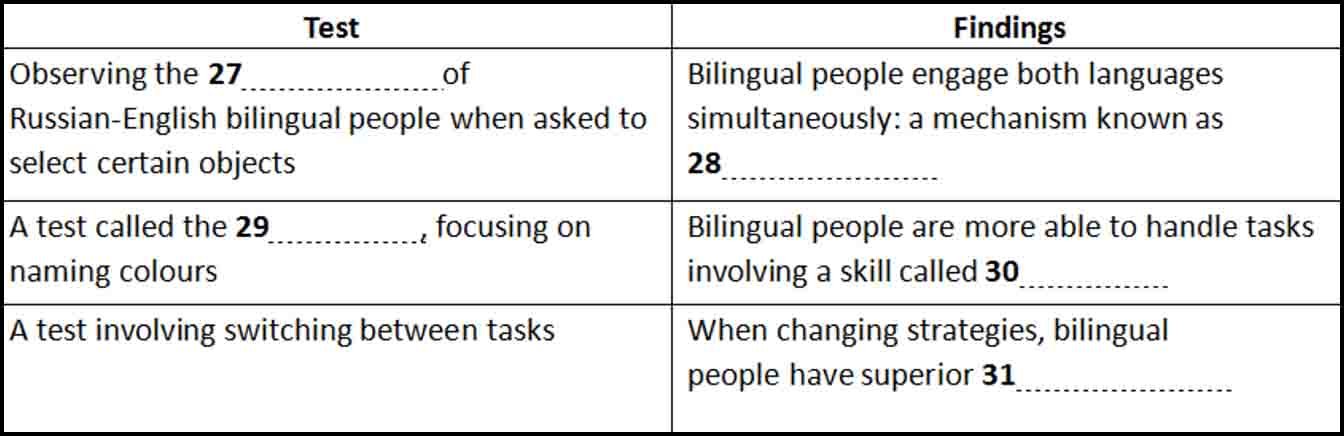
Some of the most compelling evidence for this phenomenon , called ‘language co-activation’, comes from studying eye movements.
这种现象称之为“语言共激活”,对此眼动研究提供了一些最令人信服的证据。
A Russian-English bilingual asked to ‘pick up a marker’ from a set of objects would look more at a stamp than someone who doesn’t know Russian, because the Russian word for ‘ stamp ’, marka, sounds like the English word he or she heard, ‘marker’.
让一位俄英双语能力者从一组物品中选择”marker”,相较于不懂俄语的人来说,他/她将会更多地关注一张邮票,因为俄语中“邮票”这个单词marka听起来很像他/她听到的英语单词“marker”。
In cases like this, language co-activation occurs because what the listener hears could map onto words in either language.
在类似这种情况下,由于听者听到的单词可以匹配任意一种语言,语言共激活现象就发生了。
C Having to deal with this persistent linguistic competition can result in difficulties, however.
C 但是,处理这种持续性的语言竞争会导致困难。
For instance , knowing more than one language can cause speakers to name pictures more slowly, and can increase ‘tip-of-the-tongue states’, when you can almost, but not quite, bring a word to mind.
举例来说,知道不止一种语言会导致说话者在命名图片时速度更慢,并且可能增大“舌尖现象”出现的频率,即你几乎能够但又无法当即想到某一个词的情况。
As a result, the constant juggling of two languages creates a need to control how much a person accesses a language at any given time.
结果就是,同时应付两种语言产生了对一个人在规定时间可以获得的词汇量加以控制的需要。
For this reason, bilingual people often perform better on tasks that require conflict management.
鉴于这个原因,双语能力者经常在冲突管理的任务上表现更为优秀。
In the classic Stroop Task, people see a word and are asked to name the colour of the word’s font.
在传统的Stroop任务中,人们看到一个单词,并被要说出其字体的颜色。
When the colour and the word match (i.e., the word ‘red’ printed in red), people correctly name the colour more quickly than when the colour and the word don’t match (i.e., the word ‘red’ printed in blue).
当颜色和单词匹配的时候(也就是说“红色”这个单词被打印成了红色),相较于颜色和单词不匹配的情形(即单词“红色”被打印成为蓝色),人们会更快地正确说出单词的颜色。
This occurs because the word itself (‘red’) and its font colour (blue) conflict.
这种现象发生是因为“红色”这个单词本身和它字体的颜色“蓝色”是冲突的。
Bilingual people often excel at tasks such as this, which tap into the ability to ignore competing perceptual information and focus on the relevant aspects of the input.
双语能力者常常善于完成这样的任务,它需要能力去忽略有冲突的知觉信息,并且专注输入信息与当前任务相关的部分。
Bilinguals are also better at switching between two tasks; for example, when bilinguals have to switch from categorizing objects by colour (red or green) to categorizing them by shape (circle or triangle), they do so more quickly than monolingual people, reflecting better cognitive control when having to make rapid changes of strategy.
双语能力者也更擅长在两种任务中转换。举例来说,当双语能力者必须得从按颜色(红色或者绿色)分类物体这个任务转换到按照形状(圆形或者三角形)分类物体的任务时,他们要比单语能力者转换的速度快。在他们必须得做出快速的策略改变时反映出更好的认知控制能力。
D It also seems that the neurological roots of the bilingual advantage extend to brain areas more traditionally associated with sensory processing.
D 似乎双语优势的神经根源延伸到与更为传统的感觉信息处理相关的大脑区域。
When monolingual and bilingual adolescents listen to simple speech sounds without any intervening background noise, they show highly similar brain stem responses.
当单语和双语能力的青少年听简单的语音的时候,在没有任何干扰的背景噪声的情况下,他们则会显示高度相似的脑干反应。
When researchers play the same sound to both groups in the presence of background noise, however, the bilingual listeners’ neural response is considerably larger, reflecting better encoding of the sound’s fundamental frequency, a feature of sound closely related to pitch perception .
然而,当研究者播放相同的声音给相同的群体时,在有背景噪声存在的情况下,双语听力者的神经反应要大得多,反映出更好的对声音基本频率加密的能力,这是与音调感知密切有关的一种声音特性。
E Such improvements in cognitive and sensory processing may help a bilingual person to process information in the environment, and help explain why bilingual adults acquire a third language better than monolingual adults master a second language.
E 认知和感觉信息处理方面的这些进步会帮助双语能力者在环境中处理信息,并且也有助于解释:相较于具有单语能力的成年人掌握第二种语言,为什么具有双语能力的成年人掌握第三种语言要更好的现象。
This advantage may be rooted in the skill of focusing on information about the new language while reducing interference from the languages they already know.
他们专注新语言的信息同时减少已知语言干扰的能力。
F Research also indicates that bilingual experience may help to keep the cognitive mechanisms sharp by recruiting alternate brain networks to compensate for those that become damaged during aging.
F 研究也表明,通过使用另外的大脑结构去补偿那些在衰老过程中受损的大脑结构,双语经历也许有助于保持敏锐的认知机制。
Older bilinguals enjoy improved memory relative to monolingual people, which can lead to real-world health benefits.
相对于单语能力者,老年双语能力者有更好的记忆力,这些有现实的健康裨益。
In a study of over 200 patients with Alzheimer’s disease, a degenerative brain disease, bilingual patients reported showing initial symptoms of the disease an average of five years later than monolingual patients.
一项包含有200多位老年痴呆症(一种退行性大脑疾病)患者的研究表明,具备双语能力的病人出现最初疾病症状的年份要比具备单语能力的病人晚5年。
In a follow-up study, researchers compared the brains of bilingual and monolingual patients matched on the severity of Alzheimer’s symptoms.
在后续的研究中,匹配不同程度的老年痴呆症症状,研究者比较了这两种不同患者的大脑。
Surprisingly, the bilinguals’ brains had more physical signs of disease than their monolingual counterparts, even though their outward behaviour and abilities were the same.
意外的是,双语能力者的大脑有更多关于疾病的物理迹象,尽管两者之间的外在的行为和能力是相似的。
If the brain is an engine, bilingualism may help it to go farther on the same amount of fuel .
如果将大脑比作为发动机,在消耗等量燃料的情形下,双语能力者能让这台发动机走更远的路。
G Furthermore, the benefits associated with bilingual experience seem to start very early.
G 再者,双语能力经历所带来的好处在很早的时候就体现出来了。
In one study, researchers taught seven-month-old babies growing up in monolingual or bilingual homes that when they heard a tinkling sound, a puppet appeared on one side of a screen.
在一项研究中,研究者分别教在单语家庭和双语家庭中成长的7个月大的婴儿新的规则:当他们听到叮当声时,在屏幕的一侧就会出现一只木偶。
Halfway through the study, the puppet began appearing on the opposite side of the screen.
研究进行到一半时,这只木偶则开始出现在屏幕的另一侧。
In order to get a reward, the infants had to adjust the rule they’d learned; only the bilingual babies were able to successfully learn the new rule.
为了得到奖励,婴儿们必须要调整他们所学到的规则。只有双语家庭中的婴儿能够成功学习这条新规则。
This suggests that for very young children, as well as for older people, navigating a multilingual environment imparts advantages that transfer far beyond language.
这项研究表明,对于很小的孩子或者老年人来说,驾驭双语环境能够赋予其远远超越语言本身的优势。