[C5T2P1]Bakelite
The Birth of modern Plastics
In 1907, Leo Hendrick Baekeland, a Belgian scientist working in New York, discovered and patented a revolutionary new synthetic material.
1907 年,Leo Hendrick Baekeland 这位在纽约工作的比利时科学家发现了一种革命性的新型合成材料,并且申请了专利。
His invention, which he named "Bakelite", was of enormous technological importance, and effectively launched the modern plastics industry.
他把它命名为“酚醛塑料”。这一发现具有重大的技术意义,开启了现代塑料行业的大门。
The term ‘ plastic ’ comes from the Greek plassein, meaning ‘to mould’.
“塑料”一词来自希腊语 plassein,意为“塑造”。
Some plastics are derived from natural sources, some are semi-synthetic (the result of chemical action on a natural substance ), and some are entirely synthetic , that is, chemically engineered from the constituents of coal or oil.
有的塑料来自于天然材料;有的则是半合成塑料(天然材料发生化学反应);还有的是全合成塑料,即利用煤或石油的某些成分通过化学作用合成而来的塑料。
Some are ‘thermoplastic’, which means that, like candlewax, they melt when heated and can then be reshaped.
有一些称为“热塑性塑料”,就好像蜡烛一样,遇热会熔融,从而可以用来二次成形;
Others are thermosetting': like eggs, they cannot revert to their original viscous state, and their shape is thus fixed for ever.
还有一些称为“热硬化性塑料”,就好像(煮熟的—译者注)鸡蛋一样,被固定在同一个形状,永远无法回到原始的胶着状态。
Bakelite had the distinction of being the first totally synthetic thermosetting plastic .
酚醛塑料的不同之处在于,它是第一种全合成的热硬化性塑料。
The history of today's plastics begins with the discovery of a series of semi-synthetic thermoplastic materials in the mid-nineteenth century.
现代塑料的历史可以追溯到 19 世纪中叶。当时发现了一系列可以用于制造半合成热塑性塑料的物质。
The impetus behind the development of these early plastics was generated by a number of factors - immense technological progress in the domain of chemistry, coupled with wider cultural changes, and the pragmatic need to find acceptable substitutes for dwindling supplies of 'luxury’ materials such as tortoiseshell and ivory .
这些早期塑料发展背后的动力来源于诸多因素,例如化学领域巨大的技术进步和广泛的文化变革,而且人们需要找到一种可以接受的替代品取代供给不断萎缩的龟甲和象牙之类的“奢侈品”。
Baekeland's interest in plastics began in 1885 when, as a young chemistry student in Belgium, he embarked on research into phenolic resins, the group of sticky substances produced when phenol ( carbolic acid ) combines with an aldehyde (a volatile fluid similar to alcohol).
Baekeland 的对于塑料的兴趣开始于 1885 年。当时,还在比利时学化学的他,就开始着手研究酚醛塑料(即苯酚和乙醛化合后生成的黏性物质)。
He soon abandoned the subject, however, only returning to it some years later.
然而,他很快放弃了这项研究,几年后才重新继续。
By 1905 he was a wealthy New Yorker, having recently made his fortune with the invention of a new photographic paper.
到了1905 年,他已经是个富有的纽约人了,因为他通过发明一种新型相纸发了大财。
While Baekeland had been busily amassing dollars, some advances had been made in the development of plastics.
在他忙于赚钱的过程中,塑料行业已经有了重大的发展。
The years 1899 and 1900 had seen the patenting of the first semi-synthetic thermosetting material that could be manufactured on an industrial scale.
1899 年和 1900 年,第一种可以工业化生产的半合成热硬性塑料材料被申请了专利。
In purely scientific terms, Baekeland's major contribution to the field is not so much the actual discovery of the material to which he gave his name, but rather the method by which a reaction between phenol and formaldehyde could be controlled, thus making possible its preparation on a commercial basis.
从纯科学角度来看,Baekeland 在该领域的主要贡献并不在于它发现了这种以他名字命名的材料,而在于它发现了苯酚和乙醚之间发生化学反应的方式,从而使其得以被商业化应用。
On 13 July 1907, Baekeland took out his famous patent describing this preparation, the essential features of which are still in use today.
1907 年 7 月 13 日,Baekeland 拿出了他那份用来描述这个化学反应的著名专利,该化学反应的基本特性一直沿用到今天。
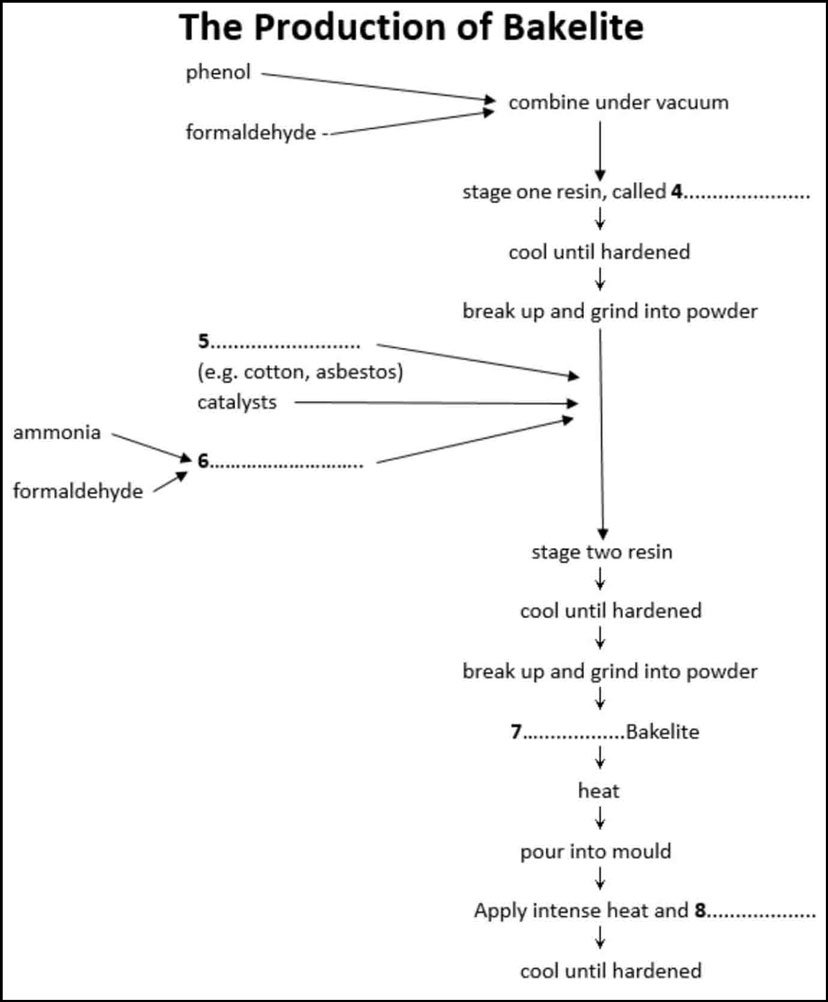
The original patent outlined a three-stage process, in which phenol and formaldehyde (from wood or coal) were initially combined under vacuum inside a large egg-shaped kettle.
最初的那份专利描述了一个分为三步的工艺过程。首先,苯酚和甲醛(来自于木头或木炭)在一个巨大的椭圆体真空罐内发生化合作用,
The result was a resin known as Novalak, which became soluble and malleable when heated.
生成一种脂,称为 Novalak,这种脂遇热可溶并具有延展性。
The resin was allowed to cool in shallow trays until it hardened, and then broken up and ground into powder.
它被放置在浅底盘中冷却硬化,之后被研成粉末。
Other substances were then introduced: including fillers, such as woodflour, asbestos or cotton, which increase strength and moisture resistance , catalysts (substances to speed up the reaction between two chemicals without joining to either) and hexa, a compound of ammonia and formaldehyde which supplied the additional formaldehyde necessary to form a thermosetting resin.
然后加入一些其他物质,包括各种填充物,如木屑、石棉或棉花(用以提高强度和防潮性)、催化剂(用以提高化合反应的速度),以及 hexa(氨和甲醛的化合物,用来提供合成热硬性塑料所需的大量甲醛)。
This resin was then left to cool and harden, and ground up a second time.
生成的脂随后被自然冷却硬化,然后再次被研成粉末。
The resulting granular powder was raw Bakelite, ready to be made into a vast range of manufactured objects.
这些粉末就是酚醛塑料,可以用于制造各种适于工业化生产的产品。
In the last stage, the heated Bakelite was poured into a hollow mould of the required shape and subjected to extreme heat and pressure, thereby setting its form for life.
最后一步,加热的酚醛塑料被倒入所需形状的磨具中,并施以高温和高压,从而使之永久定型。
The design of Bakelite objects, everything from earrings to television sets, was governed to a large extent by the technical requirements of the moulding process.
酚醛塑料产品,小到耳环,大到电视机,在很大程度上要受到铸模工艺技术要求的限制。
The object could not be designed so that it was locked into the mould and therefore difficult to extract .
设计时要注意不能使产品卡在模具中而导致无法取出。
A common | general rule was that objects should taper towards the deepest part of the mould, and if necessary the product was moulded in separate pieces.
一条常用的普遍规则是:产品应该被倒插至磨具的最深处,必要时可以为某个零件独立铸模。
Moulds had to be carefully designed so that the molten Bakelite would flow evenly and completely into the mould Sharp corners proved impractical and were thus avoided, giving rise to the smooth, ‘ streamlined ’ style popular in the 1930s.
模具必须精心设计才能使熔融的酚醛塑料均匀地流淌到模具的每一个角落。直来直去的拐角被证明是无法实际操作的,所以已经不再采用,取而代之的是流行于1930 年代的圆滑的流线型拐角。
The thickness of the walls of the mould was also crucial : thick walls took longer to cool and harden, a factor which had to be considered by the designer in order to make the most efficient use of machines.
模具的厚度也非常关键,太厚会导致冷却时间过长,设计师要仔细考虑这一因素以求最高效的使用生产机械。
Baekeland's invention, although treated with disdain in its early years, went on to enjoy an unparalleled popularity which lasted throughout the first half of the twentieth century.
尽管 Baekeland 的发明在初期受到了轻蔑,但在 20 世纪前半叶却得到了前所未有的欢迎。
It became the wonder product of the new world of industrial expansion – ‘the material of a thousand uses’.
它成为工业发展新时代的神奇产品—“百变材料”。
Being both non-porous and heat-resistant, Bakelite kitchen goods were promoted as being germ-free and sterilisable.
由于具有不透水性和耐热性,酚醛塑料制造的厨房用品号称是无菌的,还可以进行消毒。
Electrical manufacturers seized on its insulating properties, and consumers everywhere relished its dazzling array of shades, delighted that they were now, at last, no longer restricted to the wood tones and drab browns of the pre- plastic era.
电子厂商抓住了其绝缘性好的特性。各地的消费者都沉醉于塑料的炫目色彩,人们高兴地发现终于有产品使他们不必像以前那样只能使用色彩单调的木制产品了。
It then fell from favour again during the 1950s, and was despised and destroyed in vast quantities.
在 20 世纪50年代酚醛塑料又一次失去了宠爱,人们开始讨厌并且大量销毁塑料产品。
Recently, however, it has been experiencing something of a renaissance , with renewed demand for original Bakelite objects in the collectors' marketplace, and museums, societies and dedicated individuals once again appreciating the style and originality of this innovative material.
然而,最近,它又经历了 一次复兴,收藏品市场的早期酚醛塑料产品又开始走俏,而博物馆,各社会阶层和爱好者们也又一次 开始热衷于这种革命性材料的风格和原创性。