[C5T2P2]What's So Funny?
The joke comes over the headphones: ‘Which side of a dog has the most hair? The left.’
听筒里传来了笑话:“狗的哪边毛更多?左边”。
No, not funny.
不好笑,
Try again.
那就再来一个。
‘Which side of a dog has the most hair? The outside.’
“狗的哪边毛更多?外边”。
Hah! The punchline is silly yet fitting, tempting a smile, even a laugh.
哈哈!这个“包袱”虽然很蠢,却又合理,引发了一阵微笑,乃至大笑。
Laughter has always struck people as deeply mysterious , perhaps pointless .
笑,对人们而言,一直很神秘,甚至毫无意义。
The writer Arthur Koestler dubbed it the luxury reflex : 'unique in that it serves no apparent biological purpose’.
作家 AK 称之为“奢侈反射”:“它的独特之处在于它没有明显的生物学目的。”
Theories about humour have an ancient pedigree .
关于幽默的各种理论古已有之。
Plato expressed the idea that humour is simply a delighted feeling of superiority over others.
柏拉图认为,幽默只是因为优越于他人而产生的愉悦感。
Kant and Freud felt that joke-telling relies on building up a psychic tension which is safely punctured by the ludicrousness of the punchline .
Kant和Freud 觉得,讲笑话要先建立一种精神上的紧张状态,然后用一个“包袱”当中的幽默把这种紧张状态安全地刺破。
But most modern humour theorists have settled on some version of Aristotle’s belief that jokes are based on a reaction to or resolution of incongruity , when the punchline is either a nonsense or, though appearing silly, has a clever second meaning.
但是现代的幽默理论家却把原理建立在亚里士多德的理论之上:笑话是对不协调的事物做出反应或提出解决方式,因为“包袱”要么尽是废话,要么有着机智的深层含义,尽管表面上有点愚蠢。
Graeme Ritchie, a computational linguist in Edinburgh, studies the linguistic structure of jokes in order to understand not only humour but language understanding and reasoning in machines.
GR,一位爱丁堡的计算语言学家,研究了笑话的语言结构,他的目的不仅是了解幽默本身,还要了解机器是如何对语言进行理解和推理的。
He says that while there is no single format for jokes, many revolve around a sudden and surprising conceptual shift.
他说,虽然笑话没有单一的模式,但是很多都围绕着突如其来、意料之外的概念切换。
A comedian will present a situation followed by an unexpected interpretation that is also apt.
喜剧演员会表演一个场景,随后给出一种意外而切题的解读方式。
So even if a punchline sounds silly, the listener can see there is a clever semantic fit and that sudden mental ‘Aha!’ is the buzz that makes us laugh.
因此,即使“包袱”听起来很蠢,但是听众却会发现语义上的聪明搭配,还会发现脑子里突然闪现的一声“哈哈”启动我们的笑声。
Viewed from this angle, humour is just a form of creative insight, a sudden leap to a new perspective .
从这个角度来看,幽默只是一种创造性思维的表现形式,是一个向新观点的突然跳跃。
However, there is another type of laughter, the laughter of social appeasement and it is important to understand this too.
然而,需要我们理解的还有另外一种笑,即社交性的安抚笑声。
Play is a crucial part of development in most young mammals.
玩耍是大部分哺乳动物成长过程中的重要内容。
Rats produce ultrasonic squeaks to prevent their scuffles turning nasty.
老鼠会发出超声波的尖叫以防止他们的混战过于激烈。
Chimpanzees have a "play-face"- a gaping expression accompanied by a panting ‘ah, ah’ noise.
黑猩猩会“扮鬼脸”,即一种打呵欠的表情伴以喘气似的“啊啊”声。
In humans, these signals have mutated into smiles and laughs.
对人类而言,这些信号变异为微笑和大笑。
Researchers believe social situations, rather than cognitive events such as jokes, trigger these instinctual markers of play or appeasement.
研究人员相信,导致一些本能反应用以标示玩耍或者安抚行为的是社交场合,而不是认知事件(如笑话)。
People laugh on fairground rides or when tickled to flag a play situation, whether they feel amused or not.
人们在游乐场游玩或者被咯吱的时候都会发笑,这标志着一种玩耍状态,不管他们是否觉得好笑。
Both social and cognitive types of laughter tap into the same expressive machinery in our brains, the emotion and motor circuits that produce smiles and excited vocalisations.
在我们的大脑中,社交类型的笑和认知类型的笑都归因于同一种表达机制,即情感和运动神经回路,二者均能使人发笑。
However, if cognitive laughter is the product of more general thought processes, it should result from more expansive brain activity.
然而,如果认知类型的笑是更加普遍的思维过程的产物,那么它应该来源于更加丰富的大脑活动。
Although Goel felt being inside a brain scanner was hardly the ideal place for appreciating a joke, he found evidence that understanding a joke involves a widespread mental shift.
尽管 Goel 觉得脑部扫描仪很难称为解读笑话的理想途径,但他还是找到了证据证明,理解笑话牵扯到各种思维活动的变化。
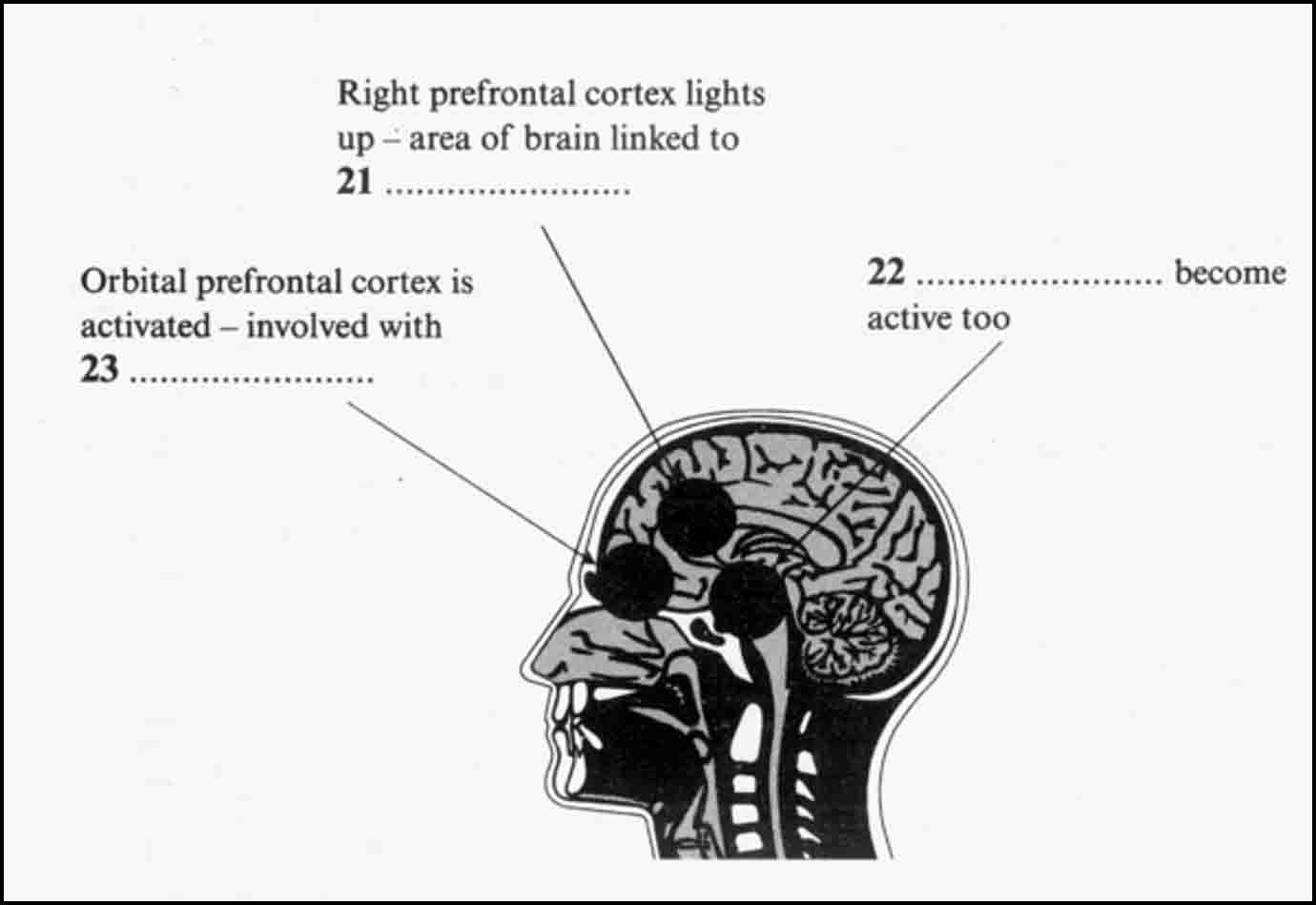
His scans showed that at the beginning of a joke the listener's prefrontal cortex lit up, particularly the right prefrontal believed to be critical for problem solving.
扫描数据表明,在开始听笑话时,听众的前额叶皮层会发亮,尤其是被认为与解决问题相关的右前额叶部分。
But there was also activity in the temporal lobes at the side of the head ( consistent with attempts to rouse stored knowledge) and in many other brain areas.
但是,头部两侧的颞叶部分也有活动发生,这与尝试激发脑部储存的知识时所发生的变化是相同的。在脑的很多其他部分也有变化发生。
Then when the punchline arrived, a new area sprang to life - the orbital prefrontal cortex.
当“包袱”抖出来的时候,大脑中的一个新区域—动眼前额叶皮层,也开始活跃起来。
This patch of brain tucked behind the orbits of the eyes is associated with evaluating information.
这部分脑组织隐藏在眼窝后,作用是对信息作出评估。
Making a rapid emotional assessment of the events of the moment is an extremely demanding job for the brain, animal or human.
对瞬间发生的事件作出快速的情感评价对于大脑而言是要求极高的一项工作,不管对动物还是对人类而言都是如此。
Energy and arousal levels may need to be retuned in the blink of an eye.
在转瞬之间,就需要对能量和觉醒度进行重新调整。
These abrupt changes will produce either positive or negative feelings.
这些快速变化可以产生或正面或负面的情绪 。
The orbital cortex, the region that becomes active in Goers experiment, seems the best candidate for the site that feeds such feelings into higher-level thought processes, with its close connections to the brain's sub-cortical arousal apparatus and centres of metabolic control.
动眼皮层(Geol 的实验中变得活跃的皮层)似乎是将这种情绪提升为更高级别的思维过程的最佳位置,因为它与大脑亚皮层的觉醒装置和新陈代谢控制的核心位置都有密切的关联。
All warm-blooded animals make constant tiny adjustments in arousal in response to external events, but humans, who have developed a much more complicated internal life as a result of language, respond emotionally not only to their surroundings, but to their own thoughts.
所有温血动物的觉醒度都会在外部事件发生时作出快速细微的调整。但是对于人类而言,由于语言导致我们具有更加复杂的心理活动,所以我们不仅会对周围事物,也会对自己的思想作出情绪上的回应。
Whenever a sought-for answer snaps into place, there is a shudder of pleased recognition.
每当一个寻找的答案出现的时候,就会出现愉悦认知带来的抖动。
Creative discovery being pleasurable , humans have learned to find ways of milking this natural response.
由于创造性发现能使人愉悦,人类已经学会找到各种方法来刺激这种自然反应。
The fact that jokes tap into our general evaluative machinery explains why the line between funny and disgusting , or funny and frightening, can be so fine.
笑话能够激发我们的总体评估机制,这一事实能够说明为什么有趣和恶心、有趣和恐惧之间的界线如此细微。
Whether a joke gives pleasure or pain depends on a person's outlook.
一个笑话到底能使人愉悦还是使人痛苦也取决于每个人的观点是什么。
Humour may be a luxury, but the mechanism behind it is no evolutionary accident.
幽默可能是一种奢侈,但是从进化学角度讲,隐藏在其背后的机制并不是巧合。
As Peter Derks, a psychologist at William and Mary College in Virginia, says: M like to think of humour as the distorted mirror of the mind.
正如 PD(WMC学院心理学家)所言,“我喜欢把幽默看做是一种思维的扭曲镜像,
Its creative, perceptual , analytical and lingual.
它富有创造力,有知觉,具有分析性和表达性。
If we can figure out how the mind processes humour, then we'll have a pretty good handle on how it works in general.’
如果我们能够清楚思维如何处理幽默,那么我们就能够很好地掌握它在总体上是如何工作的。”