[C5T2P3]The Birth of Scientific English
World science is dominated today by o small number of languages, including Japanese, German and French, but it is English which is probably the most popular global language of science.
当今的科学界是由少数几种语言主导的,包括日语、德语和法语,但是英语也许是全球科学界应用最普遍的语言。
This is not just because of the importance of English-speaking countries such as the USA in scientific research; the scientists of many non-English-speaking countries find that they need to write their research papers in English to reach a wide international audience.
这不仅是因为英语国家(如美国)在科研领域的重要位置。很多非英语国家的科学家发现,他们要用英语撰写论文,才能获得广泛的国际读者。
Given the prominence of scientific English today, it may seem surprising that no one really knew how to write science in English before the 17th century.
目前,科技英语具有显著作用。但令人惊讶的是,17 世纪之前,没有人知道如何用英语撰写科技论文。
Before that, Latin was regarded as the lingua franca for European intellectuals.
在那之前,拉丁语被认为是欧洲知识分子的通用语言。
The European Renaissance (c. 14th-16th century) is sometimes called the ‘ revival of learning’, a time of renewed interest in the ‘lost knowledge' of classical times.
欧洲的文艺复兴(14~16 世纪)又是被称为“学习复兴”,在那个时代,人们对古典时期的“迷失的知识”的兴趣重新燃起。
At the same time, however, scholars also began to test and extend this knowledge.
与此同时,学者们也开始验证并且扩展这些知识。
The emergent nation states of Europe developed competitive interests in world exploration and the development of trade.
欧洲新出现的国家对探索世界和发展贸易有着浓厚的兴趣。
Such expansion, which was to take the English language west to America and east to India, was supported by scientific developments such as the discovery of magnetism (and hence the invention of the compass ), improvements in cartography and - perhaps the most important scientific revolution of them all - the new theories of astronomy and the movement of the Earth in relation to the planets and stars, developed by Copernicus(1473-1543).
这种扩张后来把英语传入了位于西部的美国和位于东部的印度。科学的发展支撑了整个扩张过程,如磁的发现 (从而发明了指南针)、绘图学的进步、天文学新理论以及由哥白尼提出的新理论(关于地球运动与行星和恒星间的关系,大概是最重要的科技革新)等。
England was one of the first countries where scientists adopted and publicised Copernican ideas with enthusiasm.
第一批不遗余力地采纳和公开哥白尼思想的人是英国的科学家们。
Some of these scholars, including two with interests in language - John Wallis and John Wilkins - helped found the Royal Society in 1660 in order to promote empirical scientific research.
这些学者中有两位对语言也有研究,他们是 John Wallis 和 John Wilkins。他们在 1660 年协助建立了皇家学院,目的在于推进皇家的科学研究。
Across Europe similar academies and societies arose, creating new national traditions of science.
在整个欧洲,类似的学院和团体也在兴起,创造了一种新的全国性的科学传统。
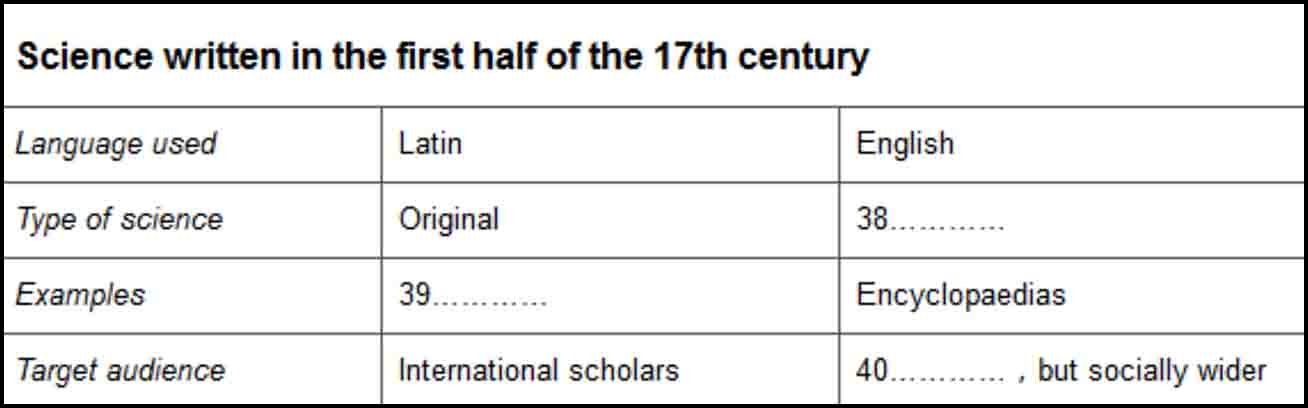
In the initial stages of the scientific revolution, most publications in the national languages were popular works, encyclopaedias, educational textbooks and translations.
在科学革命的最初阶段,大部分本国语出版的都是流行著作、百科全书、教科书和译著。
Original science was not done in English until the second half of the 17th century.
直到 17 世纪上半叶,才有人开始用英语撰写原创的科技文章。
For example, Newton published his mathematical treatise , known as the Principia, in Latin, but published his later work on the properties of light - Opticks - in English.
例如,牛顿的数学著作“Principia”是用拉丁文出版的,而后来的光学著作“Opticks”是用英语出版的。
There were several reasons why original science continued to be written in Latin.
有几个原因使得最初的科学论文都坚持用拉丁文撰写。
The first was simply a matter of audience.
第一个原因很简单,是出于读者的考虑。
Latin was suitable for an international audience of scholars, whereas English reached a socially wider, but more local, audience.
拉丁语适合用于国际学术读者的交流,而英语的读者群更广,地域性也更强。
Hence, popular science was written in English.
因此,科普文章大多是用英语撰写的。
A second reason for writing in Latin may, perversely, have been a concern for secrecy.
第二个原因可能是出于保密的考虑。
Open publication had dangers in putting into the public domain preliminary ideas which had not yet been fully exploited by their 'author'.
公开出版会把某些作者还没有研究透彻的初步想法公之于众。
This growing concern about intellectual property rights was a feature of the period - it reflected both the humanist notion of the individual, rational scientist who invents and discovers through private intellectual labour, and the growing connection between original science and commercial exploitation .
当时的人们越来越关心这种知识产权,这是那一时期的特点。这既反映了当时独立的、理性的科学家(他们通过个人的脑力劳动进行发明创造,并且发现新思想)的人文学理念,也反映了原创科学和商业应用之间的关联在不断增强。
There was something of a social distinction between 'scholars and gentlemen' who understood Latin, and men of trade who locked a classical education.
在那些理解拉丁语的“学者和绅士”与缺少经典教育的商人之间存在着某种社会地位的差别。
And in the mid-17th century it was common practice for mathematicians to keep their discoveries and proofs secret, by writing them in cipher , in obscure languages, or in private messages deposited in a sealed box with the Royal Society.
在 17 世纪中叶,数学家对自己的发现和论证进行保密是很常见的做法,他们用密码或者晦涩难懂的文字撰写论文,或者干脆以私人留言的形式密封保存在皇家学院。
Some scientists might have felt more comfortable with Latin precisely because its audience, though international, was socially restricted .
有些科学家更热衷于使用拉丁语,也许是因为尽管拉丁语的读者群很国际化,但是在社交方面却有局限性。
Doctors clung the most keenly to Latin as an 'insider language'.
医生们仍然不遗余力地把英语看作“内部语言”。
A third reason why the writing of original science in English was delayed may have been to do with the linguistic inadequacy of English in the early modern period.
第三个原因是前现代时期英语在语言学上存在的不充分性。
English was not well equipped to deal with scientific argument.
英语还不足以用来论证科学。
First, it lacked the necessary technical vocabulary .
首先,英语缺乏必要的技术术语。
Second, it lacked the grammatical resources required to represent the world in an objective and impersonal way, and to discuss the relations, such as cause and effect, that might hold between complex and hypothetical entities.
其次,英语的语法资源无法客观地描述世界,也无法用于讨论那些存在于诸多复杂的假设性事实当中的各种关系(如因果关系)。
Fortunately, several members of the Royal Society possessed an interest in language and became engaged in various linguistic projects.
所幸,皇家学院的几位成员在语言方面也有兴趣,并且参与了诸多语言学研究。
Although a proposal in 1664 to establish a committee for improving the English language came to little, the society's members did a great deal to foster the publication of science in English and to encourage the development of a suitable writing style.
1664 年他们提议建立一个委员会对英语进行改良,尽管这个提议没有最终结果,但是学会成员的确做了大量工作促进英语科学文章的发表,也促进了行文样式的发展。
Many members of the Royal Society also published monographs in English.
很多皇家学会成员也用英语出版论著。
One of the first was by Robert Hooke,the society's first curator of experiments, who described his experiments with microscopes in Micrographia (1665).
第一批这样做的人包括 R E ,他是皇家学会第一位实验室主管,他在 1665 年出版的《显微成像学》中描述了他的实验过程。
This work is largely narrative in style, based on a transcript of oral demonstrations and lectures.
这部著作在风格上偏向于描述性,主要基于口头讲解和讲座的手稿。
In 1665, a new scientific journal, Philosophical Transactions, was inaugurated.
1665 年,一份新的科学杂志“哲学学报”创刊。
Perhaps the first international English-language scientific journal, it encouraged a new genre of scientific writing, that of short, focused accounts of particular experiments.
这也许是第一份以英语发行的国际性学术刊物。 它带来了一种新的学术写作风格,即对某个实验进行简洁和明确的描述。
The 17th century was thus a formative period in the establishment of scientific English.
因此,17 世纪是科技英语最初的成型期。
In the following century much of this momentum was lost as German established itself as the leading European language of science.
在后来的一百年里,随着德国获得了欧洲科技语言的领先位置,这种势头才慢慢减弱。
It is estimated that by the end of the 18th century 401 German scientific journals had been established as opposed to 96 in France and 50 in England.
据估计,到 18 世纪末,德国拥有 401 份学术杂志,而法国只有96 份,英国只有50 份。
However, in the 19th century scientific English again enjoyed substantial lexical growth as the industrial revolution created the need for new technical vocabulary , and new, specialised, professional societies were instituted to promote and publish in the new disciplines.
后来,到了19 世纪,由于工业革命需要更多的技术词汇,英语又一次经历了词汇量的巨大增长,各种新的专业性学术团体也被建立起来,专门在各个新学科推广和出版英语文章。