[C8T1P1]A Chronicle of Timekeeping
A According to archaeological evidence, at least 5,
000 years ago, and long before the advent of the Roman Empire, the Babylonians
began to measure time, introducing calendars to co-ordinate communal
activities, to plan the shipment of goods and, in particular , to regulate
planting and harvesting.
A观察至少5000 年前以及远早于罗马帝国出现时的考古学证据,我们可以看出巴比伦人已经开始测量时间,并将日历引入人类的合作活动中,如计划运输事宜等,特别是规范种植和收获等行为。
They based their calendars on three natural
cycles: the solar day, marked by the successive periods of light and darkness
as the earth rotates on its axis ; the lunar month, following the phases of the
moon as it orbits the earth; and the solar year, defined by the changing
seasons that accompany our planet's revolution around the sun.
他们的日历基于三个自然循环:基于地球自转并出现持续的明亮和黑暗的天、基于月球绕地旋转的月以及基于地球绕日旋转并发生四季变换的年。
B Before the invention of artificial light, the
moon had greater social impact.
B在人造光源发明之前,月亮有着非常广泛的社会影响,
And, for those living near the equator in
particular , its waxing and waning was more conspicuous than the passing of the
seasons.
特别是对于那些生活在靠近赤道附近的人们,因为月盈和月亏的现象比四季交替更加显著。
Hence, the calendars that were developed at the lower latitudes
were influenced more by the lunar cycle than by the solar year.
所以与太阳相比,在低纬度地区出现的日历受月亮循环的影响会更多一些。
In more
northern climes, however, where seasonal agriculture was practiced, the solar
year became more crucial .
不过,在更加靠近北部地区的气候由于种植着季节性农作物,所以太阳的影响会变得更重要。
As the Roman Empire expanded northward, it
organised its activity chart for the most part around the solar year.
当罗马帝国扩张至北方时,他们也根据太阳日历组织了绝大部分的日常活动。
C Centuries before the Roman Empire, the Egyptians
had formulated a municipal calendar having 12 months of 30 days, with five days
added to approximate the solar year.
C在罗马帝国前的几个世纪,埃及人编制了一个有12 个月,每个月有30 天,再加上额外5 天的近似于太阳日历的政府历。
Each period of ten days was marked by
the appearance of special groups of stars called decans.
每过十天,人们会用一组特殊的被称为“十天星”的星星的出现进行标记。
At the rise of the
star Sirius just before sunrise, which occurred around the all-important annual
flooding of the Nile, 12 decans could be seen spanning the heavens.
每年尼罗河洪水泛滥时,天狼星就会伴随着日出而出,而12 颗“十天星”也会一一出现在天空中。
The
cosmic significance the Egyptians placed in the 12 decans led them to develop a
system in which each interval of darkness (and later,each
interval of daylight) was divided into a dozen equal
parts.
埃及人在“十天星”中发现的这种宇宙重要性促使他们发展出了一种系统,即黑夜的间隔(之后发展到了白天的间隔)被等分成12 部分。
These periods became known as temporal hours because their duration
varied according to the changing length of days and nights with the passing of
the seasons.
这些等分被称为“昼夜时长”,不过由于季节轮回,每天日夜的长度不一也导致了“昼夜时长”的长度不是一样的。
Summer hours were long, winter ones short; only at the spring
and autumn equinoxes were the hours of daylight and darkness equal.
夏天的“白昼”要长一些,冬天的短一些,只有在春分和秋分的时候白天和黑夜的长是一样的。
Temporal hours, which were first adopted by the Greeks and then the Romans, who
disseminated them through Europe, remained in use for more than 2, 500 years.
“真时”的概念被希腊人首先使用,后来被罗马人沿用并传播至欧洲,一直使用了2500 多年。
D In order to track temporal hours during the day,
inventors created sundials, which indicate time by the length or
direction of the sun's shadow.
D为了在白天追踪“昼夜时长”,人们发明了通过观察影子的长度或方向指示时间的日晷。
The sundial 's counterpart , the water clock,
was designed to measure temporal hours at night.
而类似于日晷的水钟也被用来在晚上测量“昼夜时长”。
One of the first water
clocks was a basin with a small hole near the bottom through which the water
dripped out.
最初的水钟之一是一个靠近底部有一个小孔的盆,水滴可以通过这个小孔滴出。
The falling water level denoted the passing hour as it dipped
below hour lines inscribed on the inner surface.
由于盆的侧面标记了代表时间的刻度,所以人们可以从水滴出后盆内露出的时间线来判断时间。
Although these devices
performed satisfactorily around the Mediterranean , they could not always be
depended on in the cloudy and often freezing weather of northern Europe.
尽管这些设备在地中海地区的准确度令人满意,但是在北欧多云及寒冷天气下却没有那么精确。
E The advent of the mechanical clock meant that
although it could be adjusted to maintain temporal hours, it was naturally
suited to keeping equal ones.
E机械钟的出现意味着尽管它们可以被调整到能够准确地表达“昼夜时长”,不过它们还是更适合去提示等分的时间。
With these, however, arose the question of when to
begin counting, and so, in the early 14th century, a number of systems evolved.
由于这些原因,从何时开始计时成了一个问题,所以在14 世纪早期形成了一系列的机制。
The schemes that divided the day into 24 equal parts varied according to the
start of the count: Italian hours began at sunset,
Babylonian hours at sunrise, astronomical hours at midday and 'great clock'
hours, used for some large public clocks in Germany, at
midnight.
开始时与将一天等分为24 小时的机制有很多不同:意大利时间从日落开始,巴比伦时间从日出开始,天文时间从中午开始,而在德国很多大型公众时钟上使用的“大钟”时间是从午夜开始的。
Eventually these were superseded by 'small clock', or French,
hours, which split the day into two 12-hour periods commencing at midnight.
最后,这些方法都被“小钟”,也叫做法国时间所取代,这种方法将每天分为两个12 小时并从午夜开始计算。
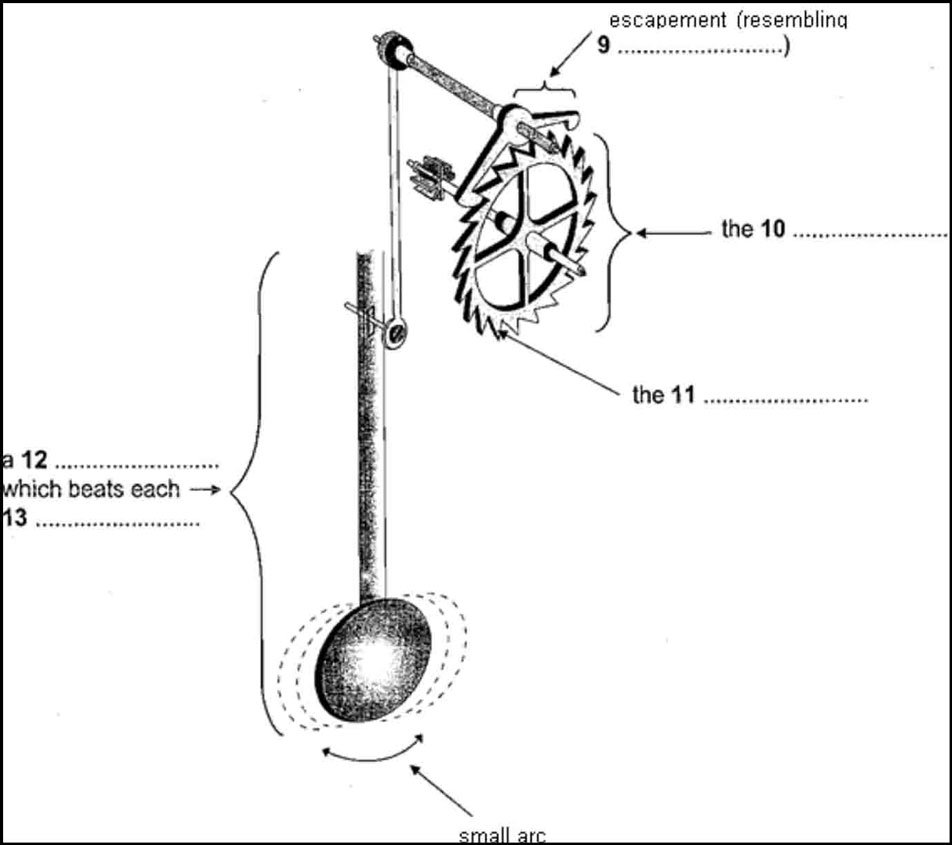
F The earliest recorded weight-driven mechanical
clock was built in 1283 in Bedfordshire in England.
F最早使用重锤装置的机械时钟的记录发生在1283 年的英国贝德福德郡。
The revolutionary
aspect of this new timekeeper was neither the descending weight that provided
its motive force nor the gear wheels (which had been around for at least 1,
300 years) that transferred the power; it was the part called the escapement.
这种新型计时器的革命性特点既不是利用下降的重力提供动力,也不是用齿轮(已经存在了1300 多年)传输能量,而是被称为擒纵器的部分。
In the early 1400s came
the invention of the coiled spring or fusee which maintained constant force to
the gear wheels of the timekeeper despite the changing tension of its
mainspring.
它是在1400 年早期伴随着螺旋弹簧或无论主弹簧的张力发生怎样的变化时都能够为计时器齿轮提供持续动力的圆锥轮而来的。
By the 16th century, a pendulum clock had been devised, but the
pendulum swung in a large arc and thus was not very efficient.
到了16 世纪,人们发明了带钟摆的时钟,不过这种时钟摆动的弧度很大导致效率不高。
G To address this, a variation on the original
escapement was invented in 1670, in England.
G为了与之匹配,1670 年在英国,一种基于原始擒纵器做出一些变化的新设备被发明出来。
It was called the
anchor escapement, which was a lever-based device shaped like a ship's anchor.
它叫做锚形擒纵器,它是一种基于杠杆原理,外形像船锚的一种设备。
The motion of a pendulum rocks this device so that it catches and then releases
each tooth of the escape wheel, in turn allowing it to turn a precise amount.
钟摆为这种设备提供动力,从而使它抓住和松开齿轮上的每个齿,依次运动以保证精确度。
Unlike the original form used in early pendulum clocks,
the anchor escapement permitted the pendulum to travel in a very small arc .
与之前钟摆时钟不同的是,锚形擒纵器使钟摆运行在一个很小的弧度内。
Moreover, this invention allowed the use of a long pendulum which could beat
once a second and thus led to the development of a new floor-standing case
design, which became known as the grandfather clock.
而且,这种发明可以使一种每秒击打一次的长钟摆被运用到设备当中,从而促使人们发明了一种全新的地面时钟装置,这种时钟也被称为祖父钟。
H Today, highly accurate timekeeping instruments set
the beat for most electronic devices.
H时至今日,高精度的计时器被运用到很多电子设备中,
Nearly all computers contain a
quartz-crystal clock to regulate their operation.
几乎所有电脑中都有石英钟用来在运行中计时。
Moreover, not only do
time signals beamed down from Global Positioning System satellites calibrate
the functions of precision navigation equipment, they do so as well for mobile
phones, instant stock-trading systems and nationwide power-distribution grids.
而且,不仅GPS 卫星发射时间信号用来为精确导航设备提供校准功能,时间信号还为手机、实时股票交易系统以及国家能源分布网络提供服务。
So integral have these time-based technologies become to day-to-day existence
that our dependency on them is recognised only when they fail to work.
这些基于时间的技术已经成为人们日常生活中不可缺少的部分,只有在它们出现问题时我们对它们的依赖性才会凸显出来。